
10 Best AI Voice Agents for Customer Service in 2026 – Honest Reviews
Here is something that blew my mind when I first saw it in action.
A customer calls in, asks a complicated question about their order status, gets transferred, asks about a refund policy, and then books a follow-up appointment , all without ever speaking to a human. The whole call? Under three minutes. Zero hold time.
That wasn’t a big enterprise with a 50-person call center. That was a mid-sized e-commerce brand using an AI voice agent.
I have been testing these tools seriously over the past several months – setting up demos, running real call simulations, talking to teams who’ve deployed them – and the gap between the good ones and the mediocre ones is enormous. Some of these actually work. Some are glorified IVR menus with a friendlier voice.
This guide breaks down the 10 best AI voice agents for customer service right now. No vendor hype, just what I actually found.
Table of Contents
What Is an AI Voice Agent?
An AI voice agent is software that manages phone calls and voice interactions with the aid of AI instead of a human rep or a clunky phone tree.
However, here is what distinguishes today’s tool from what we had half a decade ago – These are not “press 1 for billing”, “press 2 for support” systems.
An authentic AI voice agent understands natural speech, comprehends the conversation, manages interruptions, recalls what was said three sentences back, and is self-aware enough to decide when to escalate the issue to a human counterpart.
The best ones can:
- Reply to inbound calls round the clock without any staffing cost
- Make outbound calls to remind an important issue, book appointments, or follow up after the conversation
- Pull customer data in real time from your CRM
- Hand off to a live agent mid-call with full context already transferred
- Speak in multiple languages without switching tools
They’re not perfect replacements for human agents on complex emotional calls. But for the repetitive 70-80% of call volume most support teams deal with? They handle it well.
Reasons Why More Businesses Are Shifting to AI Call Agents
I very well know the reasons that make certain people skeptical about switching to AI call agents. They feel their customers wish to speak to a real person. Maybe.
But let us be honest about what “talking to a real person” often actually means – waiting on hold for 12 minutes, getting transferred twice, and explaining your problem from scratch each time.
An AI calling agent doesn’t put people on hold. It doesn’t have a bad day. It doesn’t forget what was said at the start of the call.
In fact, you will be surprised to know this: 67% of Fortune 500 companies are now running production voice AI systems!
Here is what teams I have spoken to consistently report after deploying voice AI:
- Call resolution time drops significantly. Routine queries that used to take 8-10 minutes with a human get handled in 2-3.
- After-hours coverage becomes a non-issue. No more “our office is closed” messages , the AI handles it.
- Human agents get better calls. They can allow AI to take care of the routine activities while their team focuses on the really important calls that require a human touch.
- Cost per interaction falls fast. Not immediately – setup takes real effort – but within a few months the math usually works.
How I Evaluated These Tools
I wasn’t just reading feature pages. Here is what I actually looked at:
- Voice quality and naturalness – Does it seem like a robot from the year 2015 or something a customer would actually let go?
- Conversation handling – Can it follow a real, messy, non-linear conversation? What happens when the caller goes off-script?
- Integration depth – How well does it connect to real CRMs, ticketing systems, and databases?
- Setup complexity – Can a small team deploy this without a dedicated engineering team, or does it require months of configuration?
- Escalation handling – How gracefully does it hand off to a human when needed?
- Pricing transparency – Is the pricing clear, or do you need a sales call just to get a number?
- Small business viability – Which of these actually work if you’re not an enterprise with a six-figure budget?
Quick Comparison Table
Tool | Best For | Voice Quality | Setup Difficulty | Pricing Model |
Bland AI | High-volume outbound | ⭐⭐⭐⭐ | Moderate | Per-minute |
Vapi | Developers & custom builds | ⭐⭐⭐⭐ | Technical | Per-minute |
| Inbound support | ⭐⭐⭐⭐⭐ | Moderate | Per-minute | |
Synthflow | Small business, no-code | ⭐⭐⭐⭐ | Easy | Subscription |
Air AI | Long autonomous calls | ⭐⭐⭐⭐ | Moderate | Per-minute |
Voiceflow | Enterprise & omnichannel | ⭐⭐⭐⭐ | Complex | Subscription |
Twilio Voice AI | Existing Twilio users | ⭐⭐⭐ | Technical | Usage-based |
Google CCAI | Large enterprise | ⭐⭐⭐⭐ | Very complex | Enterprise |
Poly AI | High-end enterprise | ⭐⭐⭐⭐⭐ | Complex | Enterprise |
ElevenLabs Conversational AI | Voice quality priority | ⭐⭐⭐⭐⭐ | Moderate | Per-character |
10 Best AI Voice Agents for Customer Service , Honest Reviews
1. Bland AI
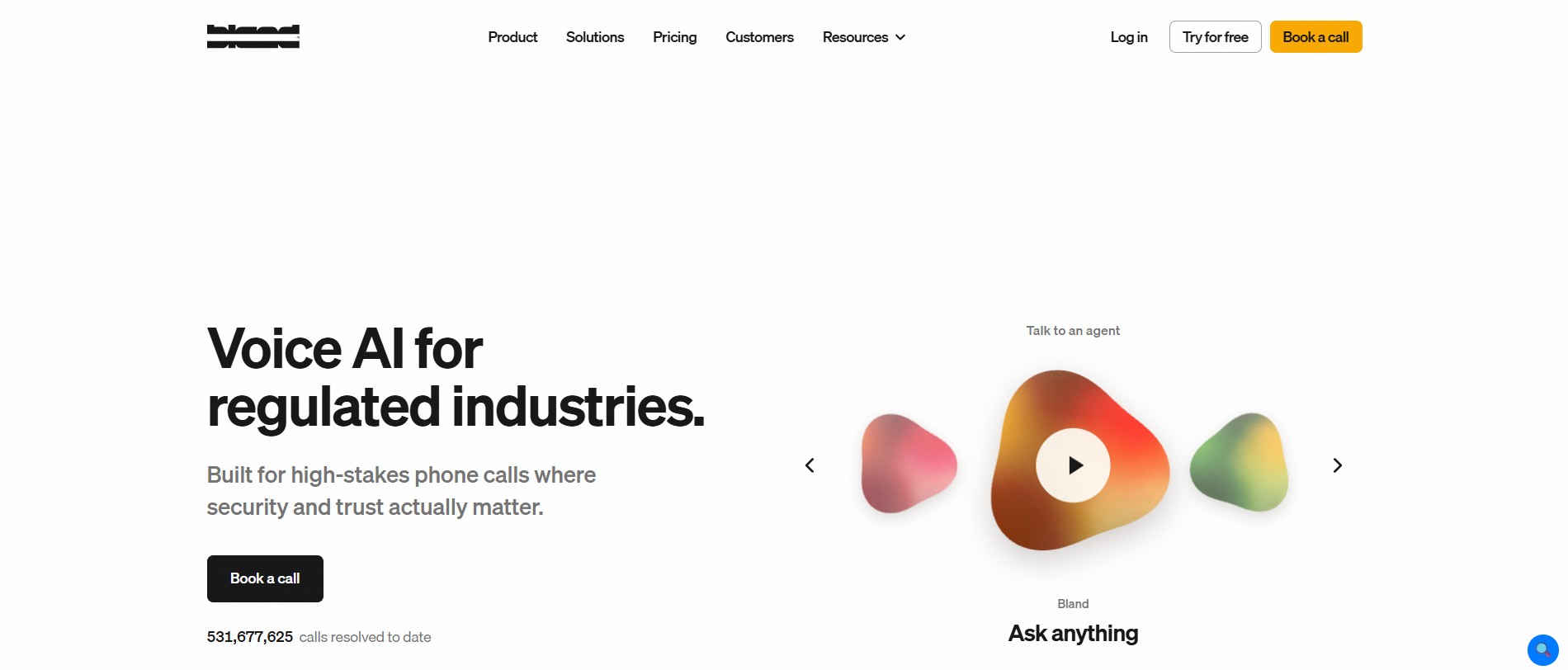
Best for: Teams running high-volume outbound calling campaigns
Bland AI caught my attention early because of one thing: scale. We’re talking about running thousands of concurrent AI phone calls simultaneously. If you’re doing appointment reminders, lead follow-ups, or customer surveys at volume, this is the one to look at first.
The voice quality is solid , not the best on this list, but natural enough that most people won’t immediately clock it as AI. The conversation flows feel real, especially for structured outbound use cases where the call has a defined script and goal.
Setup is straightforward for developers, less so for non-technical teams. You’re building call pathways through their API, which gives you flexibility but requires some engineering investment upfront.
What teams use it for: Appointment confirmations, debt collection follow-ups, sales outreach at scale, customer satisfaction surveys.
The honest downside: Inbound handling is less polished than outbound. If your main need is complex inbound support, there are better options. Also, the pricing adds up fast at high call volumes , run the numbers carefully before committing.
Bottom line: The best ai calling agent for outbound scale. In case volume is your objective, this is where I would start.
2. Vapi
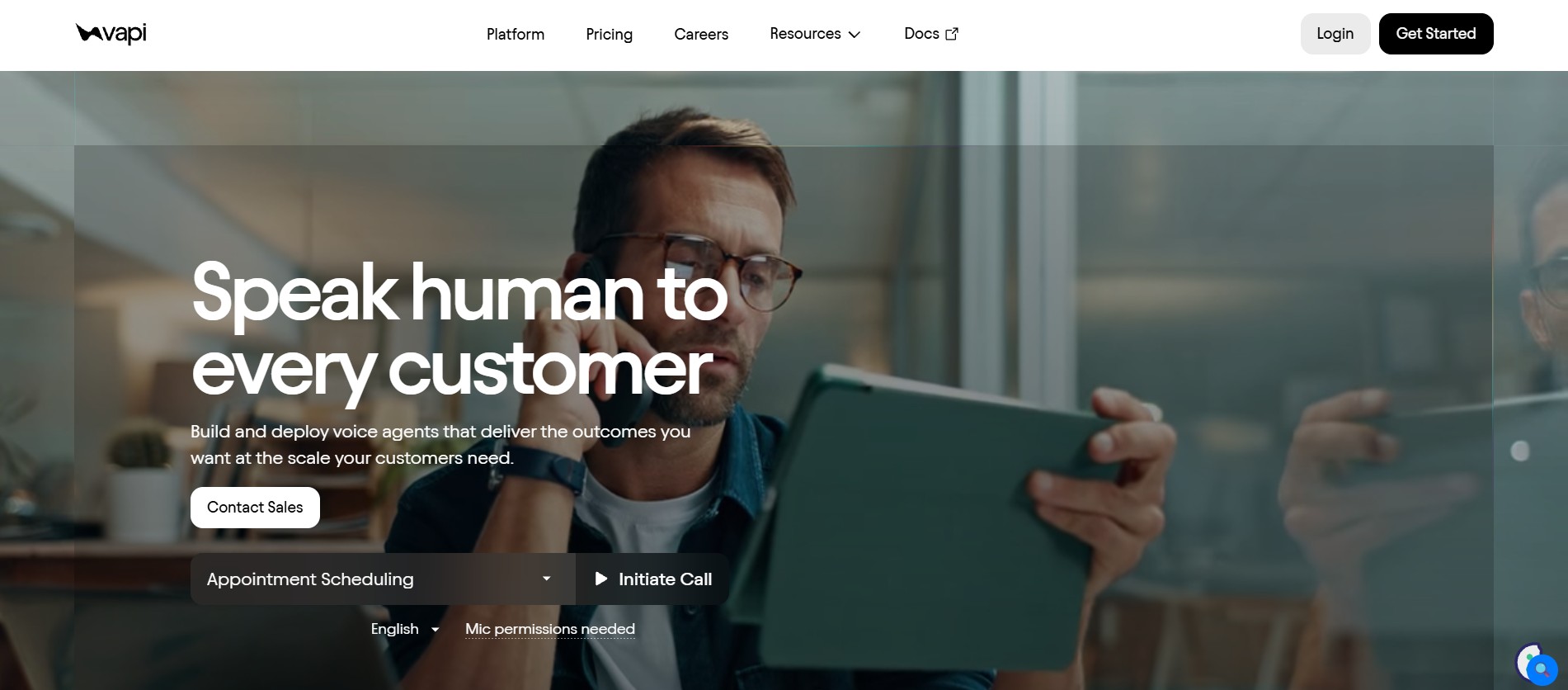
Best for: Developers who want to build something custom
Vapi is what you choose when you need complete control over how your AI voice agent behaves, and you have the technical team to build it.
It is an API-first platform. You bring your own LLM like GPT-4, Claude, whatever, and plug in your voice provider of choice such as ElevenLabs, Deepgram, Azure, and build the call logic yourself. That sounds like a lot, and it is, but it also means you’re not locked into whatever assumptions a no-code platform makes about how your calls should work.
Teams that make effective use of Vapi develop genuinely sophisticated agents – the ones that query live databases mid-call, branch on the basis of customer history, and manage multi-turn conversations that can break simpler tools.
What teams use it for: Custom AI phone agents for specific industries (healthcare scheduling, real estate, fintech), internal tools, complex multi-step call flows.
The honest downside: Non-technical teams will struggle here. This is a developer tool. If you don’t have engineering resources, look at Synthflow or Retell instead. Documentation is good but the learning curve is real.
Bottom line: The most flexible best ai call agent platform for teams with engineering capacity. High ceiling, high effort.
3. Retell AI
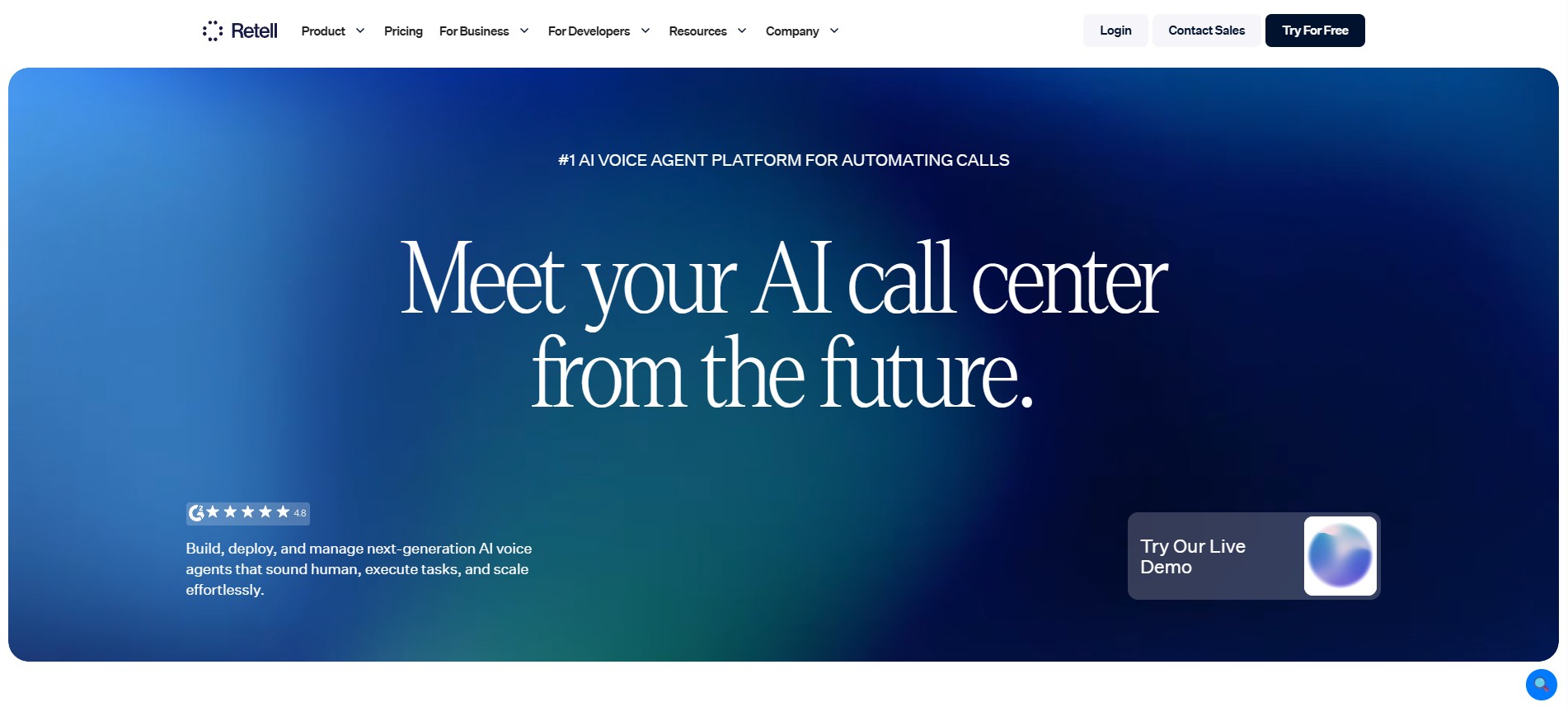
Best for: Inbound customer support, especially for mid-sized teams
Retell is the one I keep recommending to people who ask “okay but which one actually works well for inbound support calls?”
The conversation quality is genuinely impressive. Interruptions are handled naturally, if a caller cuts the AI off mid-sentence to change their question, Retell adapts without getting confused or restarting its response. That seems to be a small thing till you have utilized a tool that does not do it, and the call seems to be as if you are speaking with a broken robot.
The platform seems to find a sweet spot between flexibility and seamless usability. You can develop fairly complex call flows without requiring you to write code, and the integrations with well-known CRMs like HubSpot, Zendesk, and Salesforce that come pre-built and really work like magic.
What teams use it for: Inbound customer support, FAQ handling, appointment booking, basic troubleshooting, after-hours coverage.
The honest downside: Outbound at scale isn’t where Retell shines, that’s more of a Bland AI use case. The pricing per minute can also get meaningful if call volumes are high; model it out before you sign up.
Bottom line: My top pick for best voice ai for customer support on inbound calls. Strong conversation quality, reasonable setup complexity.
4. Synthflow
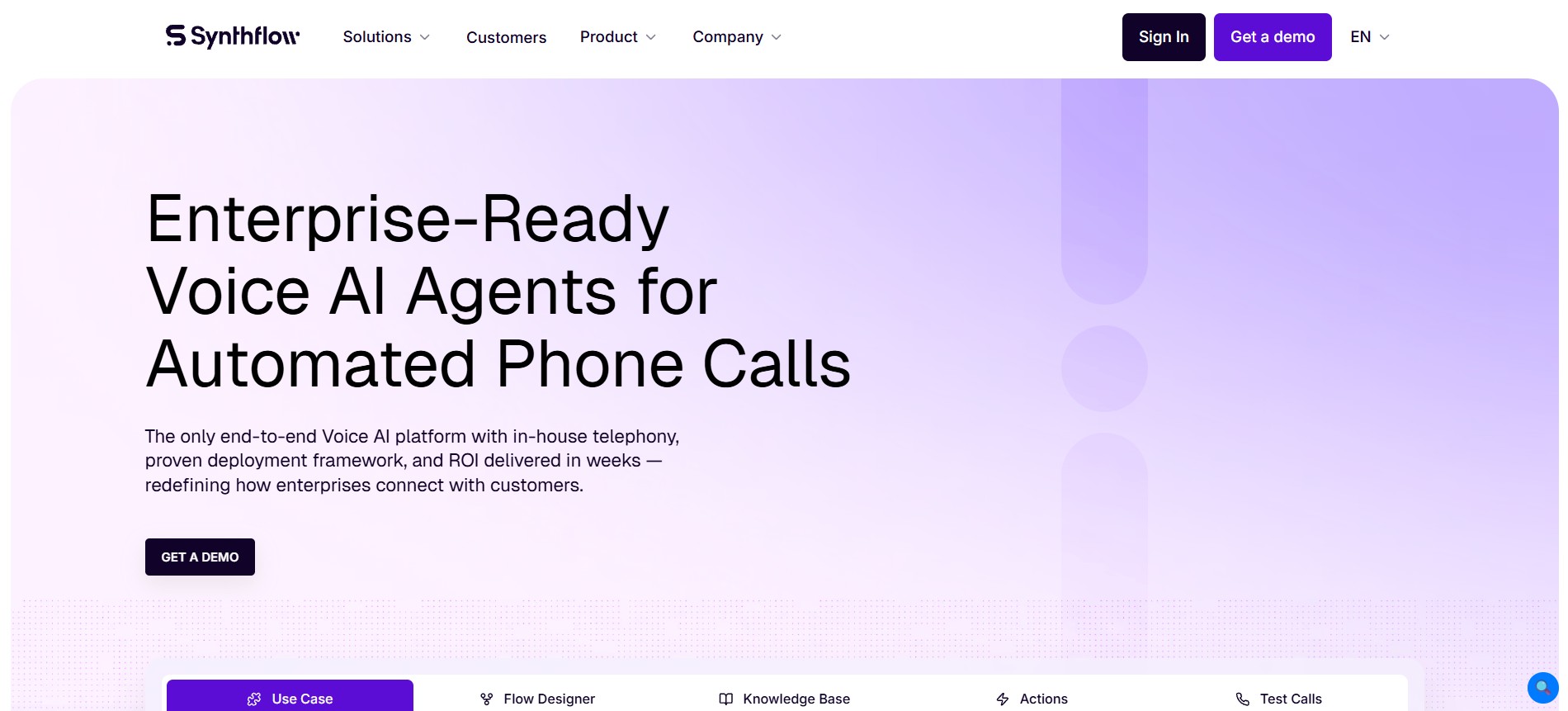
Best for: Small businesses who need this working without a technical team
This is the answer to the question “which ai voice agent is best for small businesses.” Synthflow is built specifically for teams who don’t have developers and don’t want to spend three months on implementation.
The no-code builder is genuinely usable. You can configure call flows, connect your calendar, set your business hours, and have a working AI phone agent live in a day or two. I’ve seen small service businesses – law firms, med spas, contractors – deploy this without any outside help.
Voice quality is good. I have to admit this is not the best tool on this list. But, the one thing that makes it acceptable is its prowess to manage business calls with the help of pre-built templates that help perform mundane tasks quickly.
What teams use it for: After-hours call handling, appointment scheduling, lead qualification for small service businesses, basic customer FAQ.
The honest downside: The customization ceiling is lower than developer-first tools. If you need something truly complex or deeply integrated with a custom tech stack, you’ll hit the limits of what Synthflow can do. It’s built for common use cases, not edge cases.
Bottom line: Best ai voice agent for small businesses, full stop. Fastest path from zero to working agent.
5. Air AI
Best for: Long autonomous calls that need to feel human
Air AI has a specific claim that made me skeptical at first: it can handle calls lasting 10-40 minutes autonomously, without human intervention. That’s a bold promise. Most AI voice tools work great on 2-3 minute calls and start falling apart on longer, more complex ones.
Having tested it, I’ll say , it largely delivers on that. The conversation memory across a long call is notably better than most competitors. It tracks what was established early in the conversation and references it naturally later, which is how real conversations work.
It also connects to thousands of apps through integrations, meaning it can actually do things during a call , not just talk, but pull data, update records, trigger workflows.
What teams use it for: Complex sales calls, detailed customer onboarding, multi-step support interactions that require actual system actions.
The honest downside: The pricing isn’t the most transparent, and the setup to get full value out of the integrations takes real configuration time. Also , long calls handled by AI aren’t right for every customer base. Know your audience before deploying.
Bottom line: The best ai phone agent for extended, action-oriented conversations. Impressive if your use case fits.
6. Voiceflow
Best for: Enterprise teams building omnichannel voice + chat experiences
Voiceflow started as a tool for building Alexa skills. It’s evolved into something much bigger , a full conversation design platform that handles voice, chat, and everything in between.
If you need a single platform to manage customer interactions across phone, web chat, WhatsApp, and more , with consistent logic and a unified view , Voiceflow is one of the few tools that can actually pull that off.
The visual builder is powerful once you learn it. Teams can design complex conversation trees, set up A/B testing on different call flows, and analyze where conversations are breaking down.
What teams use it for: Large-scale customer service deployments, omnichannel conversation design, enterprises that need governance and team collaboration on their AI voice strategy.
The honest downside: It’s genuinely complex to master. Small teams will be paying for capabilities they don’t use. And the pricing reflects the enterprise positioning , this isn’t the budget option.
Bottom line: Best for enterprise voice AI programs that need omnichannel reach and serious conversation design tools. Overkill for most small businesses.
7. Twilio Voice AI
Best for: Teams already deep in the Twilio ecosystem
If your business already runs on Twilio for SMS, calls, or communications infrastructure , adding Twilio’s AI voice layer is the path of least resistance.
One benefit of it is its tight integration with everything else Twillo handles. This includes recording, call routing, transcription, and AI handling all from a uniform place. This simplifies both the billing and the tech stack.
The AI conversation quality is decent enough, albeit not class-leading. It is a “good enough” solution for teams where the value is in the integration, not the voice AI itself.
What teams use it for: Companies already on Twilio who want to add AI handling to existing call flows without switching platforms.
The honest downside: If you’re not already a Twilio customer, there’s no strong reason to start here. The voice AI is competitive but not best-in-class. You’re essentially paying for the convenience of integration.
Bottom line: Makes a lot of sense if Twilio is already your communications backbone. Otherwise, look at Retell or Synthflow first.
8. Google CCAI (Contact Center AI)
Best for: Large enterprises with Google Cloud infrastructure
Google’s Contact Center AI is enterprise software – in every sense of that phrase. It’s powerful, deeply integrated with Google’s cloud ecosystem, and genuinely capable of handling complex customer service at a serious scale.
The natural language understanding is among the best available, which you would expect from Google.
Its analytics and reporting are unparalleled. Its integration with existing contact center platforms like Cisco, Avaya, and Genesys helps to create layers onto their infrastructures that several enterprises already have.
What teams use it for: Large contact center transformations, complex multi-intent call handling, enterprises needing enterprise-grade SLAs.
The honest downside: Implementation is a project, not a product launch. Budget 3-6 months and a real implementation partner. The pricing is enterprise. If you’re a small business reading this, this isn’t for you, and that’s fine.
Bottom line: Serious enterprise tool for serious enterprise budgets. Exceptional capability if you can deploy it properly.
9. PolyAI
Best for: Enterprise customer service where voice quality is non-negotiable
PolyAI is the premium option on this list, and it shows in the voice quality. The conversations are remarkably natural. Customers regularly don’t realize they’re talking to an AI until they’re told.
They work with major brands in hospitality, retail, and financial services, and the product reflects that , it’s built for high-stakes customer interactions where a robotic-sounding agent would damage the brand.
The platform handles complex, multi-intent conversations well. A caller who wants to check an order status, ask about a return, and then book a store appointment can do all three in one call without the AI losing the thread.
What teams use it for: Brand-sensitive customer service, hospitality bookings, financial services support, retail customer experience.
The honest downside: This is an enterprise product with enterprise pricing and an enterprise sales process. No self-serve, no quick signup. If you’re not ready for a proper procurement conversation, this isn’t the entry point.
Bottom line: The best voice quality on this list. If your brand demands it and your budget allows it, PolyAI sets the standard.
10. ElevenLabs Conversational AI
Best for: When voice quality is the top priority
ElevenLabs built their reputation on text-to-speech voice quality, and that DNA carries into their conversational AI product. If you’ve ever heard their voices, you know , they’re the most natural-sounding synthetic voices available right now. Applying that to a real-time conversation agent is a meaningful differentiator.
The conversational AI product is newer than their voice synthesis work, so some of the conversation handling features are still catching up to tools like Retell or Vapi. But the voice quality gap is real and noticeable, especially if you’re deploying for a brand where the call experience matters.
Integration options are solid and growing. The setup is moderate difficulty – not a no-code tool, but accessible enough for tech-comfortable teams without deep engineering resources.
What teams use it for: Brand-forward customer interactions, high-end hospitality and retail, any use case where voice realism is worth prioritizing.
The honest downside: The conversation logic and integrations aren’t quite as mature as the more established platforms. You’re partly betting on a product that’s evolving fast.
Bottom line: Best voice quality you can get outside of enterprise contracts. If your customers are going to notice the difference – and some will – this is worth considering.
Frequently Asked Questions
1. Enumerate the best AI voice agent for customer service overall.
For most mid-sized teams: Retell AI. It hits the right balance of voice quality, conversation handling, and setup complexity. If you’re a small business without a technical team, go with Synthflow; it’s the fastest path to a working agent.
For enterprise? PolyAI. Only if voice quality is unsurpassed, Google CCAI if you are already Google Cloud-native.
2. Mention the AI voice agent that is best for small businesses.
Synthflow, by a clear margin. It’s the only one on this list genuinely built for non-technical teams. You can have something working in a day or two without touching a line of code. The features are focused on exactly what small service businesses need – appointment booking, after-hours coverage, basic FAQ handling.
3. Are AI voice agents actually good enough for real customers?
Honest answer: it depends on the call type.
For structured, repeatable calls – appointment reminders, order status checks, FAQ handling, basic troubleshooting – yes, the best tools are good enough that most customers don’t mind and many prefer the speed.
For emotionally complex calls, complaints that need empathy, or truly unusual situations – still hand those to a human. The best deployments use AI to handle the routine volume and route the hard stuff to people.
4. How much does it cost to acquire AI voice agents?
I have observed that most of the tools have set the standard charges per minute of call time. This can range from $0.05 to $0.15 per 60 seconds, contingent upon the platform and volume. Certain tools such as Synthflow provide monthly subscription plans.
To understand the pricing better, take a simple business scenario. If an AI agent handles 1,000 calls in a month, with each call lasting nearly 4 minutes, the monthly cost may come to around $200 to $600.
5. Can I use an AI calling agent for outbound calls too?
Yes, and several tools are particularly strong at this. Bland AI is the standout for high-volume outbound. Air AI is strong for longer outbound conversations. Most platforms support both inbound and outbound,
just check that the specific use case (sales outreach vs. appointment reminders vs. surveys) is one they have optimized for.
6. Is it possible for AI voice agents to integrate with my existing CRM?
The better ones, yes. Vapi, Retell, Synthflow, and majority of enterprise tools consist of pre-built integrations with some of the common CRMs such as Salesforce, Hubspot, and Zendesk. However, the depth of the integration is not uniform.
Some can only read customer data during a call, while others can trigger workflows and write updates. In case you have a custom or less common CRM, budget extra time for the integration work.
Last updated: July 2026. Pricing and features in this space change frequently; always verify current details directly with vendors.

Vivek Asrani is a tech writer and AI tools reviewer who has been consistently transforming complex technology into user-friendly stories that readers look forward to. His over a decade of experience in the IT content space allows him to impart useful information on AI tools and digital products he has practically used with a sharp eye for real-world value. His reviews are written to ensure that readers see what a tool can actually do before they think of buying and spending time on the tool. He concentrates on clarity and practical details that make technology effortless to trust and use.