
MotionMuse AI Review (2026): What It Is, What It Costs, and What to Know First
The short verdict
MotionMuse AI is a credit-based image-to-video tool that turns a still picture into a short clip, roughly four to six seconds long. The core idea works the way many competitors do: upload an image, pick a template or write a prompt, and generate. The more important questions are not about video quality. They concern what the service is mainly used for, how much of its public information can be verified, and whether you will use it in a way that respects other people’s consent.
Disclosure: This review is based on publicly available pages and third-party scan reports. It is not based on hands-on testing, and nothing here is a paid placement or affiliate recommendation.
What is MotionMuse AI?
According to the page you may land on when searching for it, MotionMuse is a web app that generates short 4-6 second videos from images, using prepared templates or a custom prompt. It also advertises a Telegram bot that lets people start without registering.
Two details deserve a caution. The page claims 450+ AI models and results in 4-6 seconds, but gives no detail on which models are used or how that speed is measured. Treat both as marketing claims until you can check them yourself.
Which website is the “real” MotionMuse?
This is where many readers get confused. The site at motionmuse-ai.com describes itself as an informational site that is not official and does not process payments. The service itself is reported on a separate domain, motionmuse.ai. If you are comparing prices or checking terms, make sure you are reading the operator’s own pages and not a third-party summary, because the numbers and policies can differ.
How MotionMuse works
The workflow it describes is simple:
- Create an account and receive starting credits.
- Upload an image or pick a template.
- Add a custom prompt or choose a ready-made animation style.
- Generate the clip.
- Download it or share it.
Paid plans add unlockable templates updated daily, “AI training tools,” and generation priority over lower tiers. Note that the same page also says templates update weekly in another section, so even basic details are inconsistent.
Pricing and what each video really costs
The informational page lists four tiers. Prices below are as shown there and may differ on the operator’s own site.
| Plan | Price shown | Credits | Approx. output |
|---|---|---|---|
| Free | $0 | 20 for new users | Basic templates only |
| Basic | $9.99 (was $12.99) | 500 | ≈ 33 images or 10 videos |
| Pro | $19.99 (was $24.99) | 2,500 | ≈ 166 images or 50 videos |
| Premium | $39.99 (was $49.99) | 10,000 | ≈ 666 images or 200 videos |
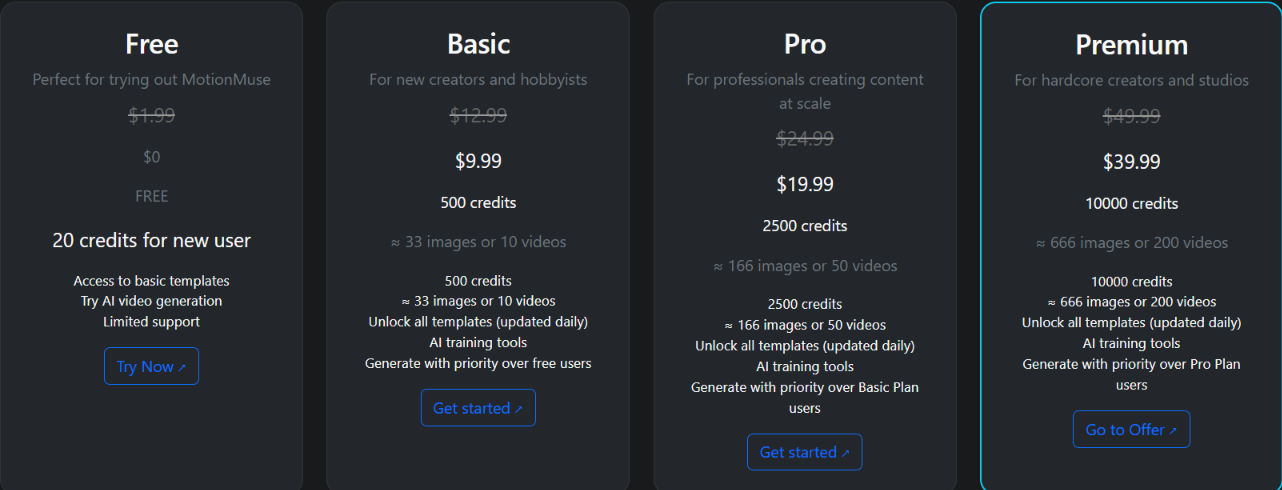
Using those figures, the implied cost per video works out to about $1.00 on Basic, about $0.40 on Pro, and about $0.20 on Premium. That is simple arithmetic from the listed numbers, not a quoted rate. It also implies that a video costs about 50 credits and an image about 15, so the 20 free credits would not cover even one full video.
Watch for common credit-model pitfalls: unused credits may not roll over, and one review aggregator reports user complaints about non-refundable credits. Read the refund and expiry terms before paying.
Trust signals: mixed, and worth checking yourself
Independent scanners disagree. One report lists trust ratings of 86 to 95 out of 100 on some platforms but a poor 25% score elsewhere, citing the domain’s young age, and overall marks the site as suspicious and unverified, noting a malware detection. Another classifies it as high risk for its adult-content category.
A fair reading is that the site is probably operating, but its reputation is unsettled. Before you pay, use a virtual or limited-balance card, read the terms of use, and avoid reusing passwords.
The content question: this is not a neutral toy
Plenty of image-to-video tools are built for marketing clips, product shots and social content. MotionMuse is described by multiple scanning services as an NSFW-oriented generator. That matters for three reasons.
Consent. Animating a photo of a real person, especially in sexualized ways, without their permission can cause serious harm. The service itself reportedly prohibits generating videos from other people’s photos without permission, but a rule on a page is only as strong as its enforcement. Reports about its moderation say outputs are scanned and explicit content may be auto-blocked, which suggests the policies are inconsistent or unclear.
Legal risk. A growing number of countries and regions treat non-consensual intimate deepfakes as a crime or a civil wrong. Rules differ by location, so do not assume that “it’s just AI” is a defense.
Platform and reputation risk. App stores have been tightening rules, and TechCrunch reported in October 2026 that Apple updated its guidelines to ban nudify apps that disguise themselves as ordinary apps to pass review. Brands and creators should think twice about association.
Who might consider it, and who should not
Reasonable use cases (adults only):
- Animating your own artwork, illustrations or AI-generated images
- Testing short loops for personal creative projects
- Using clearly licensed or original material you have rights to
Who should skip it:
- Anyone planning to use photos of other people without clear, informed consent
- Businesses that need clean brand-safe output and auditable terms
- Minors, and anyone sharing a device with minors, given the adult focus
- Anyone who wants a polished, well-documented product with strong support
Safer ways to approach image-to-video
If your goal is simply to animate still images for marketing or social content, compare tools on four points: documented content policy, transparent model information, clear refund terms, and a visible company behind the product. Mainstream creative suites and established video-AI platforms usually do better on all four. Whatever you choose, test with free credits and your own images first.
Final verdict
MotionMuse AI may produce short animated clips from images, but the public information around it is thin, inconsistent and, in places, unverifiable. Its reported focus on adult content makes consent the central issue, not a footnote. For hobbyists animating their own original images, it might be a low-cost experiment. For almost everyone else, especially brands and teams, a better-documented tool is the safer choice.
Frequently asked questions
Is MotionMuse AI free?
It offers a small starting allowance of credits for new users, but paid plans are needed for regular use.
Is MotionMuse AI legit?
It appears to operate, but scan reports conflict and some flag it as suspicious or high risk. Treat it as unverified.
Is MotionMuse AI safe for work?
Reports describe it as NSFW-oriented, so it is not a good fit for workplace or brand use.
Can I use photos of other people?
Only with their clear permission. The service reportedly forbids otherwise, and the legal and ethical risks are significant.
What should I check before paying?
The operator's own terms, refund policy, credit expiry, and who the company is. Use a card with a spending limit.

Vivek Asrani is a tech writer and AI tools reviewer who has been consistently transforming complex technology into user-friendly stories that readers look forward to. His over a decade of experience in the IT content space allows him to impart useful information on AI tools and digital products he has practically used with a sharp eye for real-world value. His reviews are written to ensure that readers see what a tool can actually do before they think of buying and spending time on the tool. He concentrates on clarity and practical details that make technology effortless to trust and use.