
What Is Freed AI?
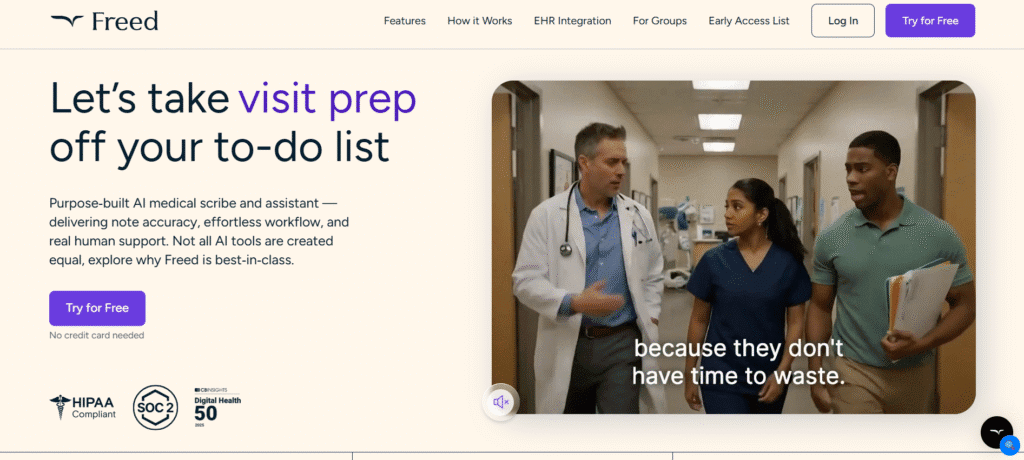
Freed AI is an intelligent assistant for doctors that listens to patient visits and writes medical notes instantly. It does more than just record; it understands and creates proper notes like SOAP formats. It saves 2–3 hours of paperwork daily, reduces stress, supports many specialties, follows HIPAA rules, and learns each doctor’s style to make personalized notes. These notes go straight into hospital systems, thanks to EHR integration.
Key Features of Freed AI
- Automated Clinical Documentation: The software records patient visits. It quickly creates complete clinical notes in SOAP format or custom templates within minutes.
- HIPAA-Compliant Security: It encrypts with high power and security regulations. This makes the information about the patients confidential and does not violate any law.
- EHR Integration: It relates to the major Electronic Health Records systems, such as Epic, Cerner, Athenahealth, etc. The transfer of notes is made with a single click.
- Multi-Specialty Support: It has been trained in numerous medical disciplines. These are primary care, cardiology, orthopedics, mental health, and pediatrics, among others.
- Personalized Documentation Style: It learns your way of writing notes. It adapts to your terminology and formatting to match your personal style.
- Real-Time Processing: It creates notes during or right after patient visits. You can review and sign them quickly.
Who Can Use
- Primary care physicians are reducing documentation time
- Specialists (cardiologists, orthopedists, dermatologists) handling complex cases
- Nurse practitioners and physician assistants managing patient loads
- Mental health professionals documenting therapy sessions
- Urgent care clinicians are seeing high patient volumes
- Telemedicine providers conducting virtual visits
- Healthcare administrators seeking efficiency improvements
Pros & Cons
Pros:
- Saves 2-3 hours daily on documentation work
- Reduces clinician burnout and improves work-life balance
- Increases patient face-time during visits
- Integrates with major EHR systems
- Adapts to individual documentation styles
- High accuracy with medical terminology
Cons:
- Requires a reliable internet connection
- Initial learning period for optimal accuracy
- May need manual review/editing for complex cases
- Occasional errors with unusual medical terms
- Privacy concerns despite HIPAA compliance
Pricing
Individual Plan: Approximately 90 USD a month per clinician. An unlimited number of patient visits, EHR integration, HIPAA-compliant storage, and basic support.
Group Practice Plan: Annual billing (volume breaks) costs approximately 84 dollars per month per clinician. Includes all individual features and an administration dashboard, team statistics, and single billing.
Enterprise Plan: Professional pricing of large groups and healthcare systems. Offers a high level of integration, specialized assistance, custom processes, and training.
Free Trial: Most of the plans include 7 days of a free trial of the platform to learn it.
(Pricing varies by specialty and features; contact Freed AI for exact quotes.)
FAQs
Q1: Is Freed AI HIPAA compliant?
Yes, Freed AI is fully HIPAA-compliant and encrypted at an enterprise level, with secure data storage and comprehensive security giving protection to patient data.
Q2: How accurate are the generated clinical notes?
Freed AI has a high accuracy (90-95%+) with clinical documentation and medical terminology. It will be more accurate when the system gets to know about your personal style and specialty.
Q3: Which EHR systems does Freed integrate with?
Freed is compatible with primary EHR systems, including Epic, Cerner, Athenahealth, eClinicalWorks, among others. For specific integration, contact Freed.
Q4: Can Freed handle multiple medical specialties?
Yes, Freed receives the training in different specialties of primary care, cardiology, orthopedics, mental health, and pediatrics, and studies the terminology peculiar to each of them.
Q5: How much time does Freed save clinicians?
Most clinicians report that they can save 2-3 hours a day during the documentation process, which allows them to see more patients, lessens their overtime, and improves their work-life balance.